
Concept for an Application of Applications

The Idea


This is a big idea! The idea is to consolidate and utilize existing Thomson Reuters products into a single application in which power users, casual users or product prospects can have the power and utility of Thomson Reuters products within a single interface and process. The Big Idea Architect (working title). This would include product info for prospects; step-by-step processes for casual users; and the aggregation of data from application to application for power users and newbies alike.
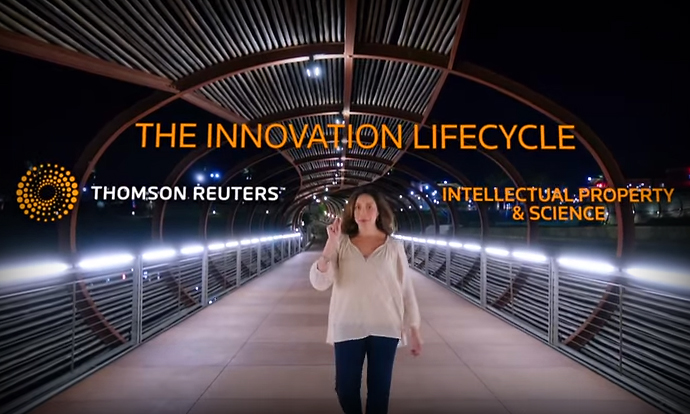 Inspired by a video titled, Thomson Reuters Intellectual Property and Science - The Innovation Lifecycle in which the lifecycle of a life-saving pill is brilliantly illustrated in a continuum of processes involving various Thomson Reuters products. The thought for The Big Idea Architect is this same continuum can be applied within a single application to provide the particular necessary tools to step a user, or a series of users, through the entire innovation process from idea to market—of course using the vast array of Thomson Reuters products.

For example, let's look at the Pharma & Life Sciences sphere, though this thought can be applied to virtually any divisional set of products similarly—Finance, Tax & Accounting, Legal, Risk Management—and in this Big Idea Architect example, it does cross divisional boundaries to use various products and services.

 The Big Idea Architect simplifies all that.
 The Mockup
Say, as in the video, a scientist discovers a "key protein" which if synthesized could make a "life-saving pill." But instead of having to research the proper tools, processes and techniques, Thomson Reuters vs. competition, she uses a single Thomson Reuters tool—The Big Idea Architect—to step through the entire process, accumulating and aggregating only the pertinent data for the job at hand—end-to-end, concept-to-market.

Through logical and psychological prompts, inputting preliminary information, combined with predictive analysis and via progressive disclosure the system might suggest starting with EndNote to begin research and target searches, to begin storing and matching data, as well as organizing and sharing found data. What the Big Idea Architect system does not do, power users aside, is bombard the user with ALL available resources, much of which sifting through may have no relevance to said project. Otherwise, just the applications and services that apply are offered, thus simplifying the first part of the process—the Discovery Research process. All the data and processes from the various products and data resources being continually aggregated into the project—all within the umbrella of The Big Idea Architect. A bit of data from Web of Science, combined with evaluations from InCites, combined with abstract management of ScholarOne, information management of Converis, and shared throughout the process with ResearcherID and/or EndNote—all in a seamless process flow.
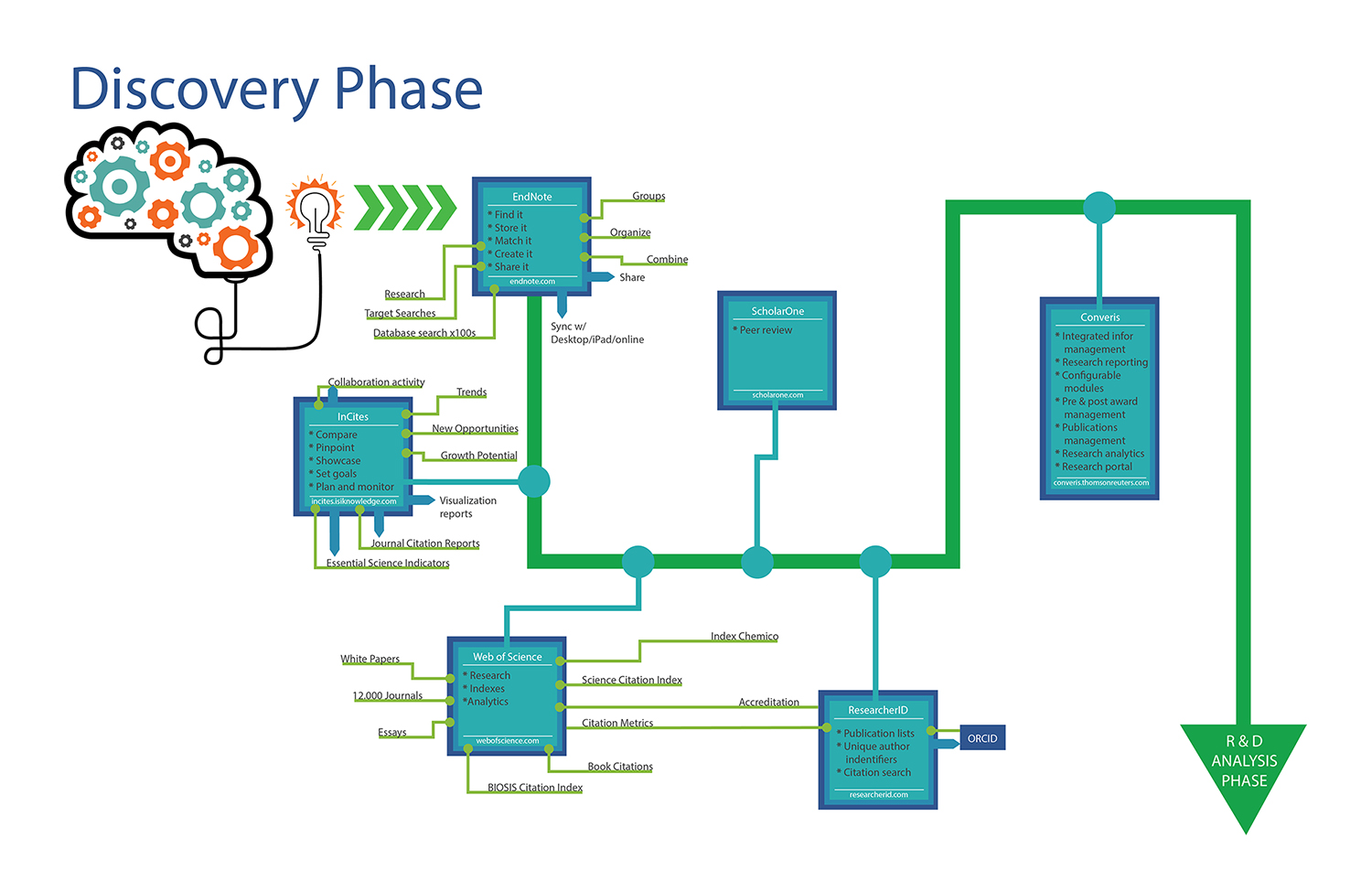
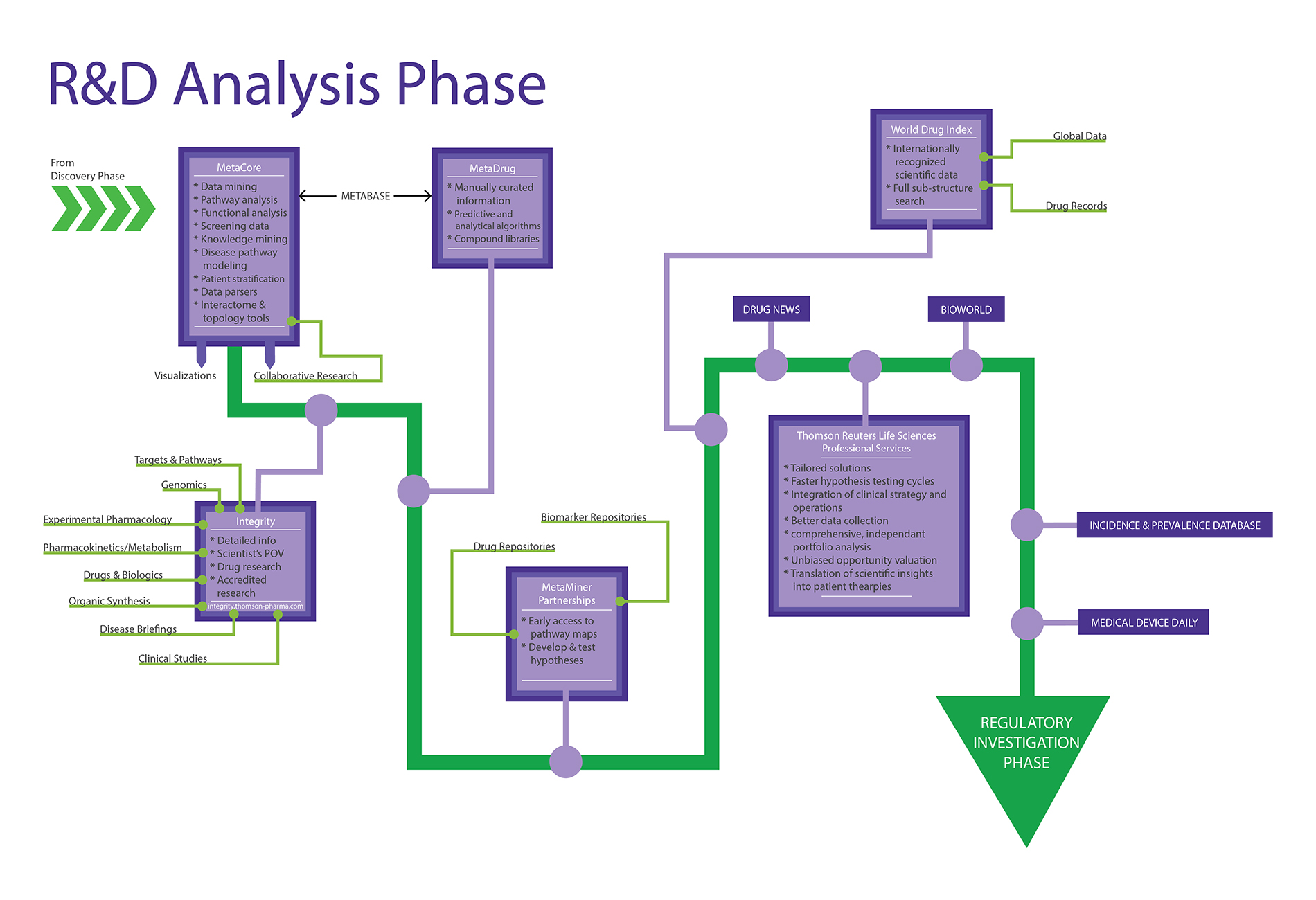
This aggregation is then moved into the R&D Analysis phase utilizing more pertinent Thomson Reuters products—MetaCore, Integrity, perhaps MetaDrug, and perhaps a collaboration link with Thomson Reuters’ Life Sciences Professional Services, or with whatever persons who need to be involved and collaborate throughout the process—researchers, scientists, assistants, peers.
Moving into the Regulatory Investigation phase, products like Thomson Reuters’ Cortellis Regulatory Intelligence Analytics ensures a solid regulatory process. Thomson Reuters Cortellis products such as Cortellis for Competitive Intelligence, Cortellis Opportunity Monitor, Cortellis for Informatics, Cortellis Data Fusion, as well as Recap IQ help guide our scientist through the Competitive Investigation process. All information smartly added into the overall project.

All along The Big Idea Architect is aggregating data and information from all the various products moving into the Patent Research phase. Thomson Reuters products like Thomson Innovation and Derwent Innovations Index come into play, along with Compumark, SAEGIS, Serions, gTLD and ccTLD.

From here the next logical phase would be Marketing—of which Thomson Reuters may currently be shy of providing. Thus a great opportunity could be had to develop various marketing tools and templates populated from the gathered information: product launches, websites, social media sites, spec sheets and other print collateral, case studies, newsletters, blogs, news releases, advertising collateral, Powerpoints and Prezis, videos, etc.
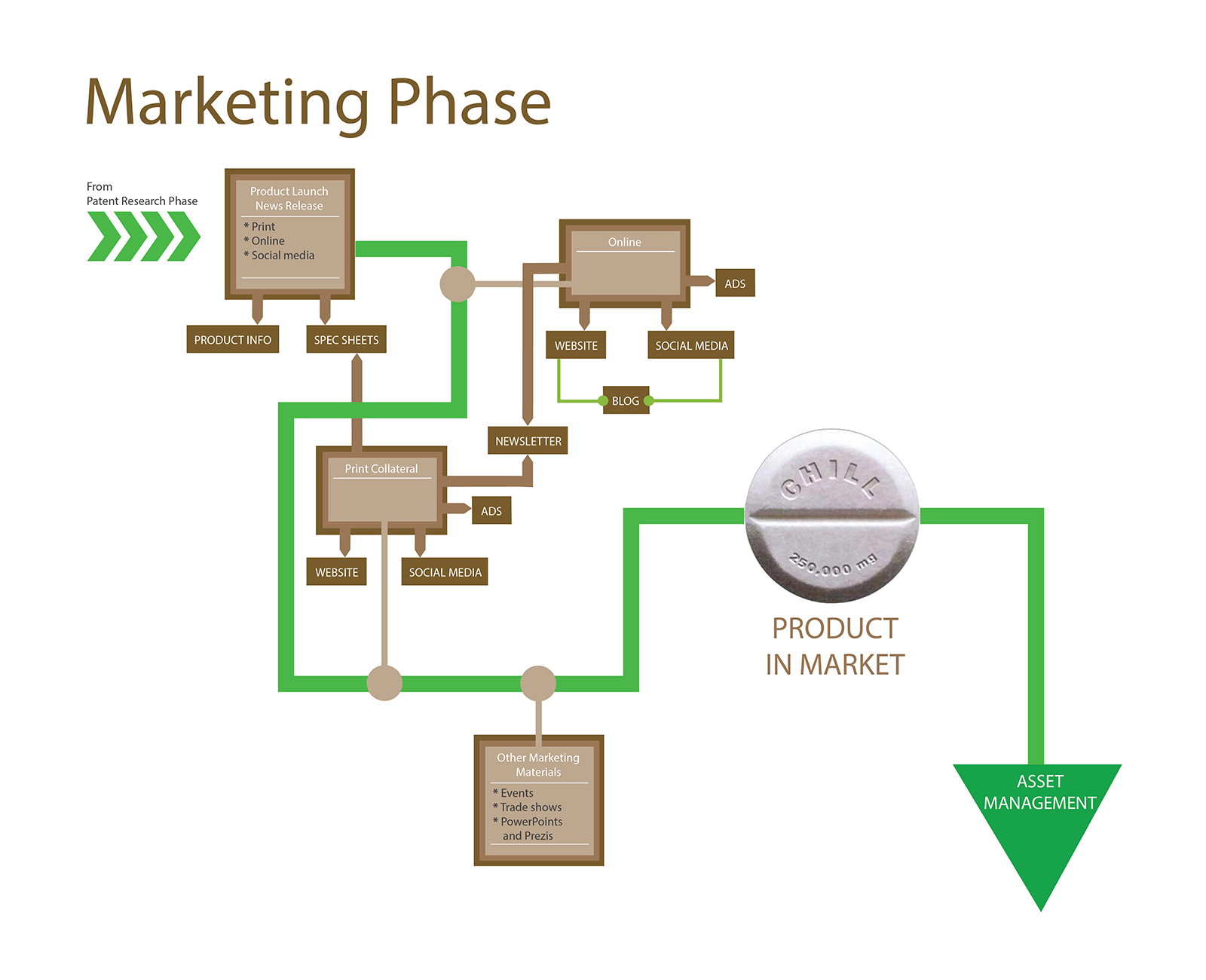
After the product is thus successfully made its way into the market, Thomson Reuters products like Thomson IP Manager with its robust Rules & Fees and PAIR features, cIPP, MarkMonitor and legal services manage and protect the existing patents and trademarks.
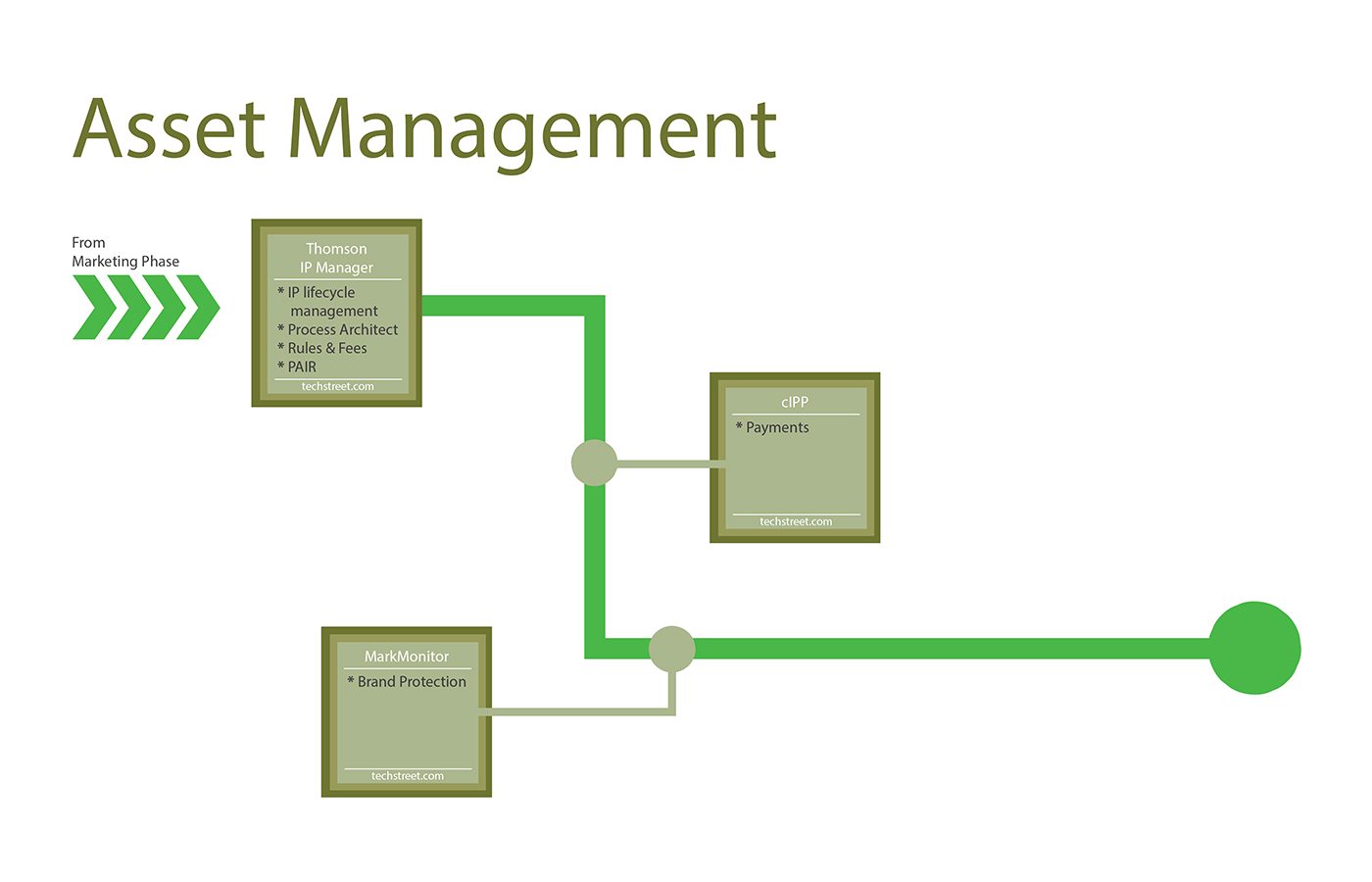
The value to all this is of course a streamlined development and management process, as well as an intuitive product for prospects, newbies, casual and power users alike to seamlessly utilize the vast array of Thomson Reuters products—from concept to completion—particularly for newbies and casual users. The power to sort and aggregate data sources and processes is powerfully found within many Thomson Reuters products already (e.g. Thomson IP Manager and cIPP). How much more powerful to take this same concept on a grander scale utilizing all Thomson Reuters products? Intuitively! The Big Idea Architect would serve as a central repository for all pertinent principles and players throughout the whole innovation lifecycle. What such a product would provide is a clean and seamless, step-by-step process to hand the baton from one principle to the next—from scientist to researcher to analyst to business to attorney to marketer to manager—all in nice, tight, cumulative “batons.”

The example given here is from a single instance uniting Thomson Reuters products and services from Pharma & Life Sciences, Scholarly & Scientific Research, Governance, Risk & Compliance, Legal, and Intellectual Property. Such a scenario could also incorporate products and services in other divisional spheres—Reuters News Agency, Financial and Tax & Accounting, etc. Seamlessly. Intuitively. Comprehensively. Smartly.
The Conclusion
This was a concept I crafted in spare moments and in following Thomson Reuters' encouragement of all employees to be innovative. The idea germinated soon after I started at TR and began working with some of the asset management products and learning about some of the other intellectual property products TR has. My earliest thoughts were of bringing these products together in a single interface. Not neccessarily in one aggregate application, but at least under a single interface in which a user would readily have access to other useful Thomson Reuters products. The idea was shelved [for awhile].

Again, it was watching the TR Innovation Lifecycle video that resurrected the idea—and with a force! It was an idea I had to get out, at least sketched out on paper. In 3-5 minute spare lots of time I did a lot of domain study, of the products, learning the lifecycle and process flows, devising logical phases, sketching and illustrating flowcharts, and then creating an HTML mockup to illustrate the entire step-by-step process (using the blue "Next Step" button to advance through). In a few months I had something to post.

Ten minutes after I post the Big Idea Architect on the The Hub, my boss gives me a thumbs-up. He said my post has generated a little flurry of emails. He later explained to me it helped articulate what One Platform is. One Platform, later to be called Project Neon, is a huge divisional initiative that I had interpretted as a platform in which to bring several products under one technological standard, not an application of applications per se. My misunderstanding wasn't alone. Little known to me the One Platform concept had a lot of misunderstandings and The Big Idea Architect helped articulate the concept. I still see The Big Idea Architect differently, though I do now recognize the overlapping similarities.
This concept is one that can be applied to other divisions, other industries, or scaled down to smaller groups of products. It is a big idea!
This is a presentation to illustrate a typical process flow. It takes you through each phase, step-by-step, showing how each different application might fit in.
 Click the blue "Next Step" button to go to the next screen and step through the entire process.
  You can also navigate back and forth to each different phase via the
