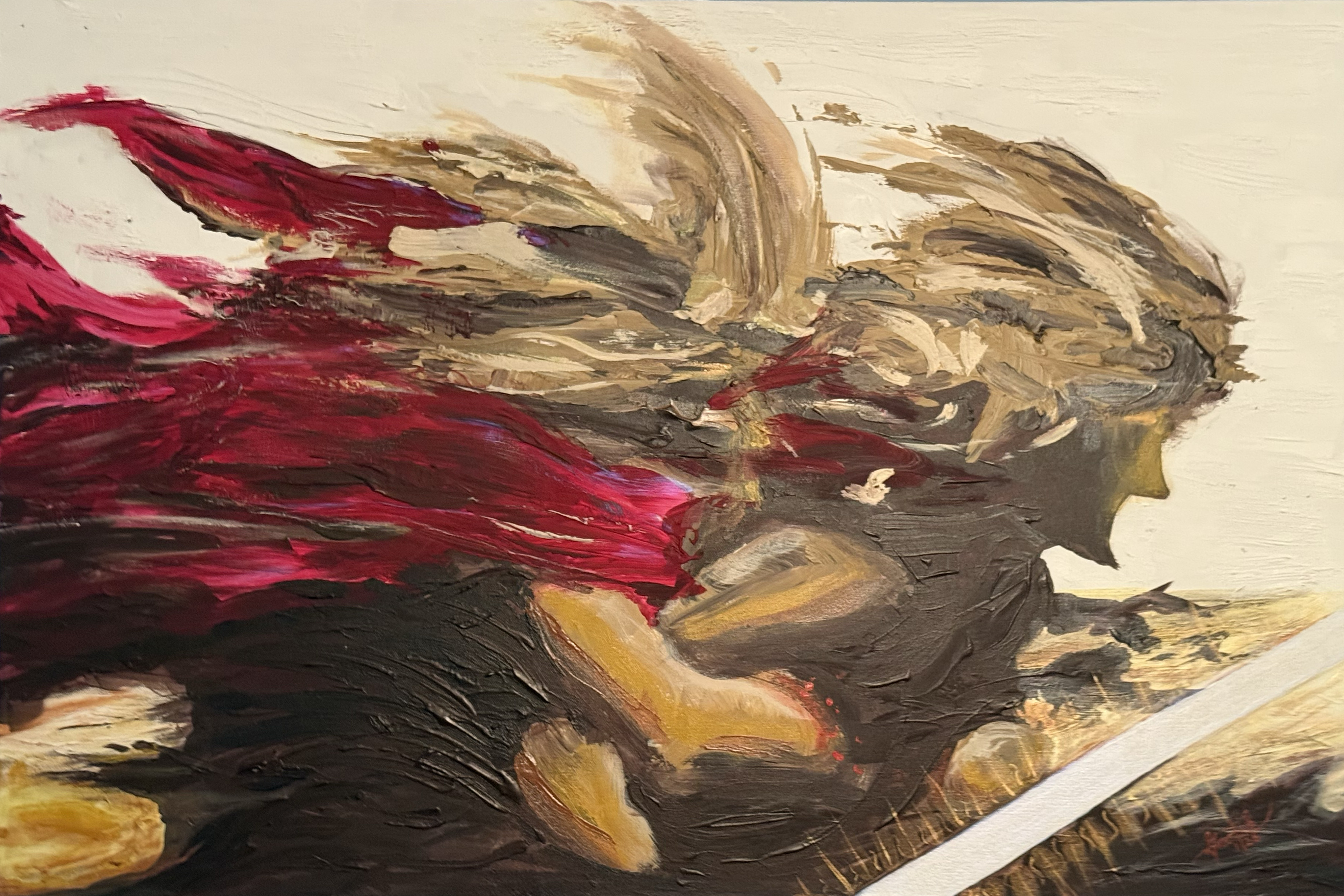
Battle for Tyrfing reimagines a moment from Norse legend not as illustration, but as force in motion. The painting centers on a forward-driving figure whose body, hair, and trailing crimson mass surge in a single direction. A pale blade cuts diagonally across the surface, clean and luminous against the dense, earth-toned ground. The sword is present—unmistakable—yet it operates less as object than as axis.
Rather than depicting a duel or a literal clash, the work focuses on inevitability. The violence associated with Tyrfing, the cursed sword of saga tradition, is not rendered through spectacle. It is revealed through propulsion: the body pitched forward, the red sweep trailing like blood, banner, or air torn by speed. The composition compresses space, pushing everything toward the blade’s trajectory.
Subtle ruptures within the flesh-toned passages suggest the cost embedded in this momentum. The wound is not theatrically displayed; it is absorbed into the structure of the painting itself. In this way, abstraction carries narrative weight. Meaning is embedded in direction, interruption, and pressure.
Echoing traditional symbols of authority, the sword acts as a perpendicular incision through horizontal strata, invoking power through structure rather than ornament. Battle for Tyrfing presents destiny not as myth retold, but as force enacted — a blade already in motion, moving beyond the moment of battle into the certainty of consequence.